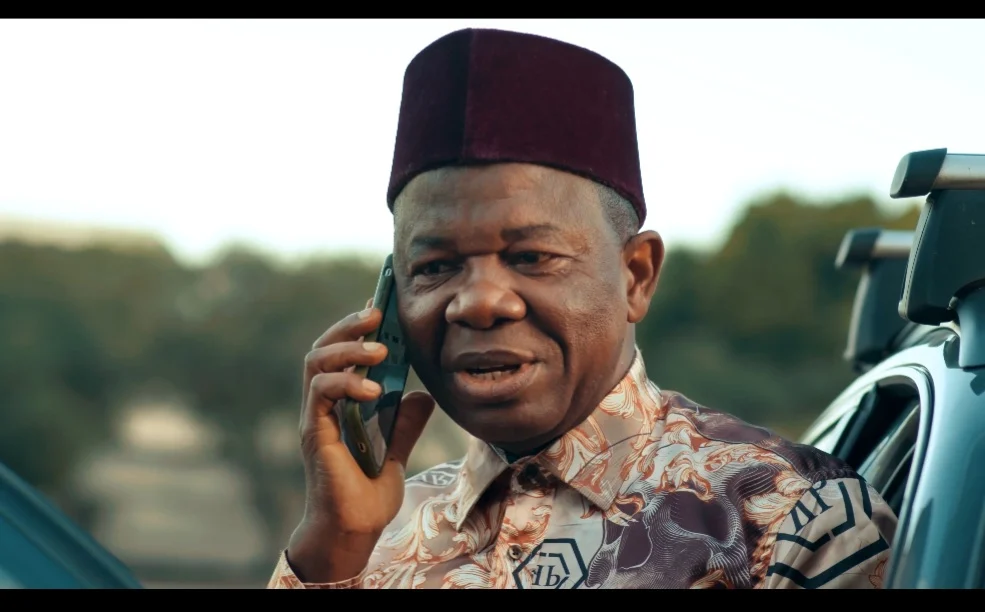
The Nigerian Film Industry (Nollywood) is also a medium through which Nigerian culture and ethics disseminates worldwide. It is the second-largest movie industry globally by output, producing about 3,500 movies annually, surpassing Hollywood.
This massive volume of storytelling is not just a commercial feat; it represents the heartbeat of a continent, projecting our values, our struggles, and our triumphs onto the global stage.
Our team at African Gist Productions sets to release Chiwetalu Agu’s international debut, “The Chaos Theory“, tomorrow, the 18th. I deem it fitting to honour Nollywood with this piece, on which foundation our filmmaking dream became a reality.
Every modern independent filmmaker stands on the shoulders of the giants who built this ecosystem out of raw determination, proving that we can tell our own stories on our own terms.
The Foundations of the Dream
Nollywood’s creation started in the early 1960s when the first Nollywood movies were being created by historical filmmakers like Hubert Ogunde, Jab Adu, Ola Balogun, Eddie Ugboma and Moses Olayia, who are considered the first generation of Nigerian filmmakers.
These visionaries transitioned from the rich traditions of travelling celluloid theatre into the early spaces of cinema, laying down the structural blueprints for everything that was to follow.
It gained more ground in the 1990s when filmmakers like Okechukwu Ogunjiofor, Kenneth Nnebue and Chris Obi Rapu produced Living in Bondage, starring Kenneth Okonkwo, Bob-Manuel Udokwu and Kanayo O. Kanayo. This historic release triggered a magnificent home-video boom.
It utilised the accessible VHS format to completely bypass traditional distribution bottlenecks, bringing localised African narratives directly into millions of living rooms across the continent.
While in the late 1990s and early 2000s, filmmakers like Teco Benson took the lead to become the pioneers of action movies in Nollywood, which also brought Nollywood to the limelight of the international audience. Through high-stakes narratives and sharp cultural pacing, these action classics expanded our cinematic borders, establishing a massive diaspora audience that hungered for African representation.
Since Nollywood cannot be compared to Hollywood in terms of movie quality, as Hollywood is older than Nollywood and thus is more technically and financially advanced. Hollywood has spent over a century refining its capital-intensive studio systems and technical pipelines, giving it a massive structural advantage in global markets.
It competes alongside its Indian counterpart, Bollywood, in meeting the Hollywood standard, although lagging in many areas like picture, sound and story qualities, which keeps it far away from bringing the Oscar home for the first time. This gap in technical execution and narrative structure remains a vital hurdle that our modern generation of filmmakers must intentionally solve.
The Oscar Conundrum and the Language Barrier
African nations have always had a mixed record at the Oscars. Thanks to Algeria, which won the Best Foreign Language Film award for the first time at the 41st Academy Awards in 1969 with “Z”, a political satire, back when the category was still known as “Best Foreign Language Film”.
(Emphasis on best foreign language film, more reason Nollywood wouldn’t bring easily, the Oscar Award, home.
Another reason I once considered writing most of my scripts in Igbo and Pidgin English, respectively, is that British English is not recognised internationally as a Nigerian language, especially in America and Europe.
Again, with its anti-war black comedy “Black And White Colour,” Côte d’Ivoire won the award in 1976, and South Africa’s “Tsotsi”, directed by Gavin Hood, won it in 2005.
But the same cannot be said of Nollywood, which is the mother of Afro-entertainment, despite its annual output and international recognition, which points to a loophole that requires filling.
Nigeria submitted a film for the Academy Award for Best International Feature Film for the first time in 2019. However, on 4 November 2019, the Academy disqualified Nigeria’s entry, as the majority of the film’s dialogue is in English. However, the following year, the Nigerian Oscar Selection Committee announced that AMPAS would allow films that are primarily in Pidgin English to be eligible for submission.
Language seems to be a barrier in bringing the Oscar home because English is not regarded as a Nigerian language, and in that regard, any movie to win the Oscar should be telling the story of a particular tribe/ culture, using their language as a depiction or a common Nigerian trait using Pidgin English, which is the Nigerian language.
True cultural authenticity cannot be accurately filtered through the vocabulary of our colonial history. To resonate on an international level, we must embrace the exact linguistic textures that define our daily realities.
Navigational Structures and the Path Ahead
Since NOSC was formed in 2013, the Nigerian Official Selection Committee, the body that submits to the academy, Nigerian titles that would compete for the IFF award, comprises 15 members, including the filmmaker Kenneth Gyang, the actor Omotola Jalade-Ekeinde, and the actor and producer Ego Boyo, among others.
The NOSC has submitted only two Nigerian titles to The Academy, 2019 Genevieve Nnaji’s Lionheart and 2020 Desmond Ovbiageli’s The Milkmaid. The Academy disqualified Lionheart on the claim that it did not meet the IFF’s language criterion; The Milkmaid was accepted but did not reach the Oscars’ nomination stage.
So the NOSC’s recent decision is the norm, not an outlier: There have been more years of absence than representation. The committee’s latest move has sparked controversy because some members of the Nigerian public wonder whether the committee wrongfully bypassed certain films. Much as I don’t buy into the bias of bypassing a movie because it favours a particular tribe.
I think we should do well in developing scripts that tell our unique stories in the depths of culture and language because they portray who we truly are as people. Maybe by so doing, someday we could bring the Oscar home. We must stop altering our art to fit Western expectations and instead focus entirely on the deep, unfiltered truths of our indigenous heritage.
The Chaos Theory will be gracing our screens on Thursday, the 18th of June. A Psychological Thriller, which was shot in Cape Town, you can read the synopsis here: “The Chaos Theory” synopsis.
A few scenes from The Chaos Theory’s set


The Film will be released on Rowlandsky Media Studios.
While we celebrate this milestone, we also look forward to collaborations that will help us make a remarkable impact in Nollywood, to help our dear Film Industry regain its lost glory.
What are your thoughts on the language barrier in international cinema? Do you believe Nollywood should prioritise localised languages like Igbo, Hausa, Yoruba and Pidgin to secure global critical acclaim? Share your thoughts, please.
About The Author