Much is being written about Germany’s status as Europe’s central economic engine.
Scholars and financial analysts routinely dissect its industrial machinery, its manufacturing prowess, and the fiscal disciplines that anchor the Eurozone.
Yet, in focusing entirely on macroeconomic charts, the global consciousness often overlooks a far quieter, systemic triumph: Germany’s absolute leadership in material recycling and planetary stewardship.
To step onto German soil is to step into a landscape where environmental consciousness is not merely an abstract, but philosophical ideal, deeply embedded in social architecture, which challenges our fundamental understanding of civic responsibility. It forces an interrogation of how human beings inhabit space, manage waste, and interact with the finite boundaries of our collective home.
Redefining the Geography of Cleanliness
The familiar adage declares that “cleanliness is next to godliness.” Historically humanity has treated this principle with a frustratingly narrow geographic scope. We attribute cleanliness almost exclusively to the micro environment, to the scrubbing of our physical bodies, the tidying of our immediate apartments, or the maintenance of our private residences.
We draw an imaginary, psychological border at our front doors. Beyond that threshold lies the street, the municipality, the state, a public vacuum where individual accountability frequently dissolves into collective neglect.
Germany dismantling this psychological border is nothing short of extraordinary. The state has pioneered a structural methodology that transforms “cleanliness is next to godliness” from a passive sentiment into rigid, actionable law.
In the German civic model, the apartment and the state are part of an unbroken continuum of ecological responsibility. One does not simply care for one’s private room; one is legally and morally bound to the preservation of the shared environment.
This is not a system built on casual, voluntary goodwill. It is a system built on meticulously structured enforcement.
The Anatomy of the Four Bins: Domestic Sorting as a Civic Ritual
The foundational battleground of German environmental management begins directly inside the kitchen.
The domestic space is governed by stringent regulations that require an absolute separation of materials at the point of consumption. Mixing waste is not merely viewed as an act of laziness; it is treated as an infringement on civic order.
To look at a standard German residential waste hub is to look at a colour-coded matrix of intentionality. The system demands that every household maintain a multi-tiered sorting apparatus, typically categorised by precise colours and specific functions:
- The Yellow Container (Gelbe Tonne): Reserved strictly for lightweight packaging, plastics, synthetic materials, aluminium, and nylons.
- The Green or Blue Container (Grüne/Blaue Tonne): Dedicated exclusively to paper, clean cardboard, and discarded literature.
- The Brown Container (Biotonne): The destination for organic matter, kitchen scraps, raw vegetable waste, and biodegradable leftovers.
- The Black Container (Restmüll): The final repository for residual, non-recyclable waste, such as used tissues, ash, and specific synthetic items that cannot be processed elsewhere.
This domestic architecture is reinforced by the ultimate frontline gatekeepers: the municipal sanitation workers.
In Germany, trash collection is not a passive utility; it is an active regulatory checkpoint. If a household fails to sort its waste correctly, the consequences are immediate and visible. Sanitation crews will routinely refuse to empty containers that contain mixed materials.
On several occasions, neighbours can be seen on the streets under direct social and logistical duress, forced to manually resort their waste bins on the sidewalk or face a total suspension of collection services alongside heavy financial penalties. The message from the state is uncompromising: if you refuse to participate in the sorting mechanism, the system will refuse to carry your burden.
Beyond the Sidewalk: The Recyclinghof and Structural Sustainability
When domestic bins reach their limits, or when life generates waste that defies standard categorisation, such as broken electronic appliances, old furniture, or scrap metal, the responsibility shifts to specialised infrastructure.
The law mandates that citizens cannot simply abandon unwanted technology or bulk items on a random street corner in hopes of an anonymous pickup.
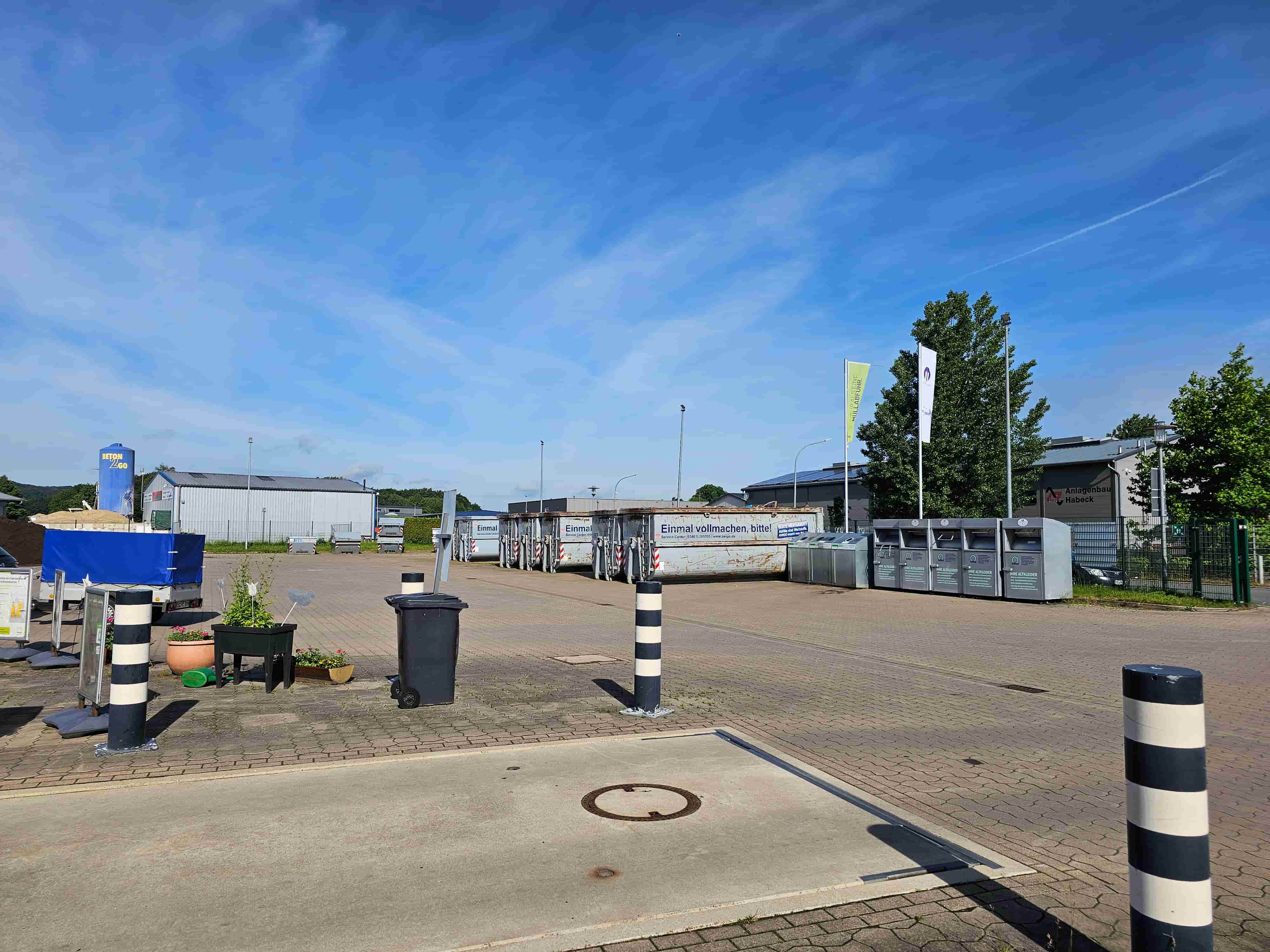
Instead, the populace relies on designated institutional sanctuaries of waste management. A prime manifestation of this is the Recyclinghof Ostercappeln;

A regional waste management facility where electronic devices, metals, bulk wood, and hazardous materials are systematically catalogued into massive, industrial-grade containers.
Visiting a facility like the one in Ostercappeln reveals the true scale of German ecological discipline. It functions with the precision of a laboratory. Citizens drive in, identify the exact container designated for their specific category of metallic or digital debris, and deposit it under the watchful eye of site managers.
By enforcing these strict drop-off structures, Germany eliminates the toxic leakage of heavy metals and electronic waste into groundwater, ensuring that the components of yesterday’s technology become the raw materials for tomorrow’s innovations.
The Philosophical Core: Connecting Environmental Sanitation to Planetary Welfare
Why does a state implement laws so stringent that they dictate the disposal of a single plastic wrapper or a broken television? The answer lies in a profound understanding of natural phenomena and a recognition of the delicate equilibrium of our biosphere.
When modern society complains about the escalating crises of climate change, notices severe irregularities in local atmospheric conditions, or experiences catastrophic shortages in natural resources, we often treat these disasters as isolated, external acts of nature. We disconnect our personal lifestyle choices from global ecological reactions.
Germany’s policy structure operates on the opposite philosophical premise. It recognises that environmental degradation is rarely the result of a single, catastrophic event; rather, it is the cumulative consequence of billions of minor, unaccountable human actions.
An untidy environment is inherently an unhealthy environment. Any piece of waste disposed of at the wrong place is either an immediate toxic hazard to local animal and human life, or an aesthetic eyesore that degrades the psychological well-being of the community.
True planetary management must begin at the micro level, at the immediate perimeter of our daily lives. By establishing actionable laws that legally bind citizens to planetary welfare, the German state protects people from the profound tragedy of the commons.
It codifies the philosophical truth that one person’s private misconduct or ecological laziness can directly compromise another person’s health, safety, and climate stability.
A Global Invitation to Reflect
Germany’s journey demonstrates that achieving elite status in material recycling requires far more than purchasing expensive processing machinery or launching public relations campaigns. It requires a fundamental shift in corporate and individual psychology.
It requires a willingness to use the rule of law to reshape the daily habits of millions of citizens until ecological mindfulness becomes as natural as breathing.
As we look upon our own communities, cities, and national structures, we are left with vital questions that demand deep introspection:
- How is waste and recycling handled within the borders of your current environment?
- Does your local or national government actively support structural environmental management, or is the burden left entirely to the whims of individual goodwill?
- What steps can we take in our private lives to ensure that planetary welfare is treated as an absolute priority rather than a distant afterthought?
The earth we inhabit is a single, interconnected sanctuary. The actions we take inside our private spaces will invariably ripple outward across the face of the globe.
Perhaps it is time for the rest of the world to look closely at the German model, pick up our designated bins, and transform our beautiful philosophies into actionable, daily rituals.
About The Author